
For decades, the architecture of a “career” appeared stable enough to be taken for granted. Yet, beneath the surface, structural forces—technological, demographic, psychological—were steadily eroding that stability. The result is visible today: traditional career pathways are fragmenting, and the very definition of work is being renegotiated.
Career X.0 argues that careers are no longer linear journeys but versioned systems, periodically reconfigured in response to change. This finale synthesises the economic, psychological and technological dynamics behind this shift, offering a sober yet hopeful assessment of what lies ahead.
Key Takeaways

- The Old Model is Broken: The traditional "corporate ladder" (Career 2.0 & 3.0) is obsolete, crumbled by technological disruption and demographic shifts

- Enter Career X.0: A new, adaptive framework focused on purpose-driven work, lifelong learning, and building a diverse portfolio of skills rather than chasing job titles

- Future-Proof Strategy: Success now depends on agility—continuously acquiring new skills and adapting to an AI-augmented landscape to build a resilient career architecture
This finale builds on the journey mapped through the earlier chapters—The Awakening, The Breaking Point, The Unseen Work, and Designing Your Career. Each stage revealed a fragments of the changing career landscape; together they provide the scaffolding for understanding the X.0 world. From awakening to designing, while we looked at transformations at an individual level, here we look at the macro from the micro, decoding the past, present, and then making predictions for what's ahead.
From Linear to Layered
Careers were never about status and income, it was just about survival. The classic progression—education, employment, retirement—was a product of the industrial era. Mass production rewarded specialisation. Corporations valued tenure. Education served as a proxy for capability. This mirrors the realisation captured in The Awakening, where individuals first sense the mismatch between outdated expectations and new workforce realities.
Digitalisation weakened these assumptions. Global labour markets became more fluid. New industries emerged faster than curricula could adapt. And now AI is accelerating this instability, not by replacing human work wholesale, but by reshaping the composition of skills required to perform it.
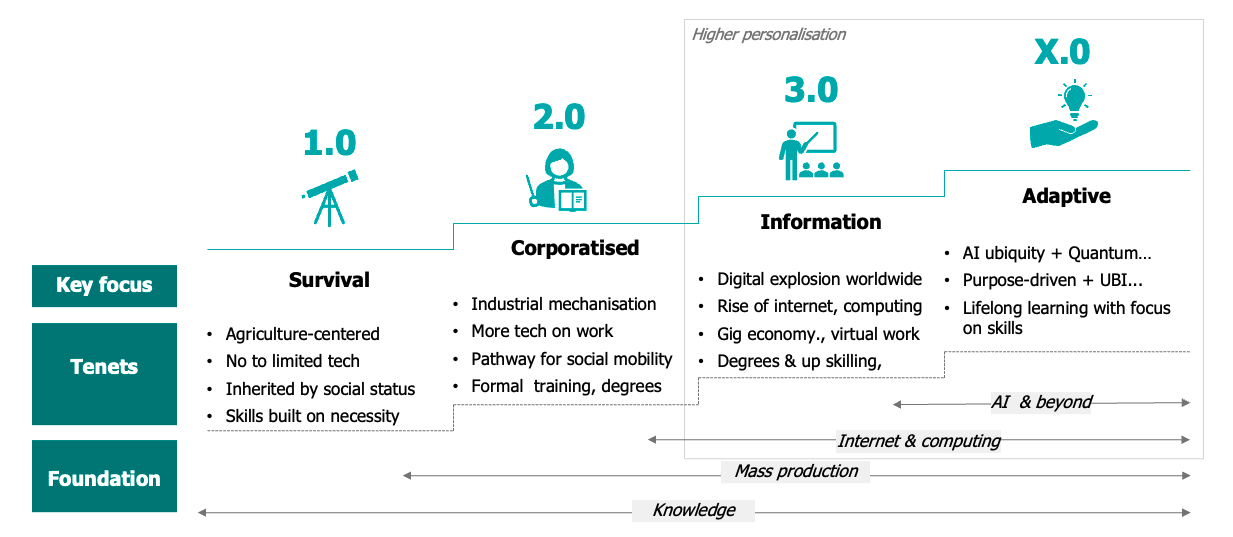
McKinsey estimates that 25–30% of global work hours may be automated by 2030, though unevenly across regions and sectors. The IMF cautions that the impact will vary dramatically depending on regulation, demographics and industry structure. And LinkedIn’s analysis that 65% of job skills may change reflects not certainty but trajectory: a labour market in motion. Put simply: even if workers do not change jobs, their jobs will change around them!
Put simply: even if workers do not change jobs, their jobs will change around them!
However, the impact will not be evenly distributed. Advanced economies with high labour costs will feel automation pressures earlier, while emerging markets may see slower transitions due to demographic advantages, informal labour structures, and slower enterprise AI adoption. The decline of degree-centrism is not a universal collapse but a sector-specific recalibration. Governments in the US, Singapore and the UAE are removing degree requirements in public hiring. Companies like IBM, Google, and Tata Consultancy Services are widening access through skills-based assessments.
However, higher education remains a strong predictor of socioeconomic mobility in many countries. Degrees are not disappearing—they are simply becoming insufficient on their own. The labour market appears to be gravitating to a hybrid equilibrium: degrees as strong foundations, skills as differentiators. This aligns with Skillstr’s central thesis: capability is becoming multi-dimensional and continuously updated—much like software versions.
Psychology of Reinvention
Neuroplasticity research from MIT and UCL confirms that adults can reconfigure neural pathways, though with more effort than children. Yet enthusiasm must be tempered: plasticity declines gradually, not dramatically, and varies across individuals. This cognitive shift is the very essence of The Unseen Work, the internal restructuring that precedes any external reinvention.
Behavioural economics adds nuance. Kahneman and Tversky showed that humans rely heavily on heuristics—not 90% uniformly, but more often in ambiguous or high-speed contexts. These heuristics, shaped by emotion, culture and experience, give humans an interpretive edge AI lacks.
AI systems, for all their sophistication, exhibit no embodied cognition, no somatic markers, and no lived experience. They simulate language and pattern but cannot internalise context. This distinction, not intelligence per se, defines the human comparative advantage. Thus, X.0 is not a celebration of reinvention for its own sake. It rests on cognitive evidence: humans retain the ability and occasionally the evolutionary need to reconfigure themselves. Here are some real life adaptations in practice:
Microsoft: Culture as Competitive Strategy

Satya Nadella’s transformation of Microsoft is often framed as cultural renaissance. More precisely, it was an operational shift anchored in psychology. By embedding “growth mindset” principles, Microsoft expanded internal mobility, accelerated cross-team learning and aligned incentives with experimentation. Financial outcomes followed, but causality flowed from mindset to method to market performance.
Airbnb: Behavioural Insight in Crisis Response

Airbnb’s pivot during the pandemic was less a triumph of agility than of behavioural understanding. With cross-border travel collapsing, Airbnb tapped into the “home region familiarity bias”: people prefer what feels local during uncertainty. By reconfiguring supply around domestic and long-term stays, Airbnb stabilised demand, a strategy informed by psychology as much as economics.
These examples illustrate a core X.0 principle: adaptation is not merely reactive.
These examples illustrate a core X.0 principle for professionals: adaptation is not merely reactive; it is interpretive, drawing on insight into how humans behave under stress and change. With the context for the reinvention set, let's look at the future ahead.
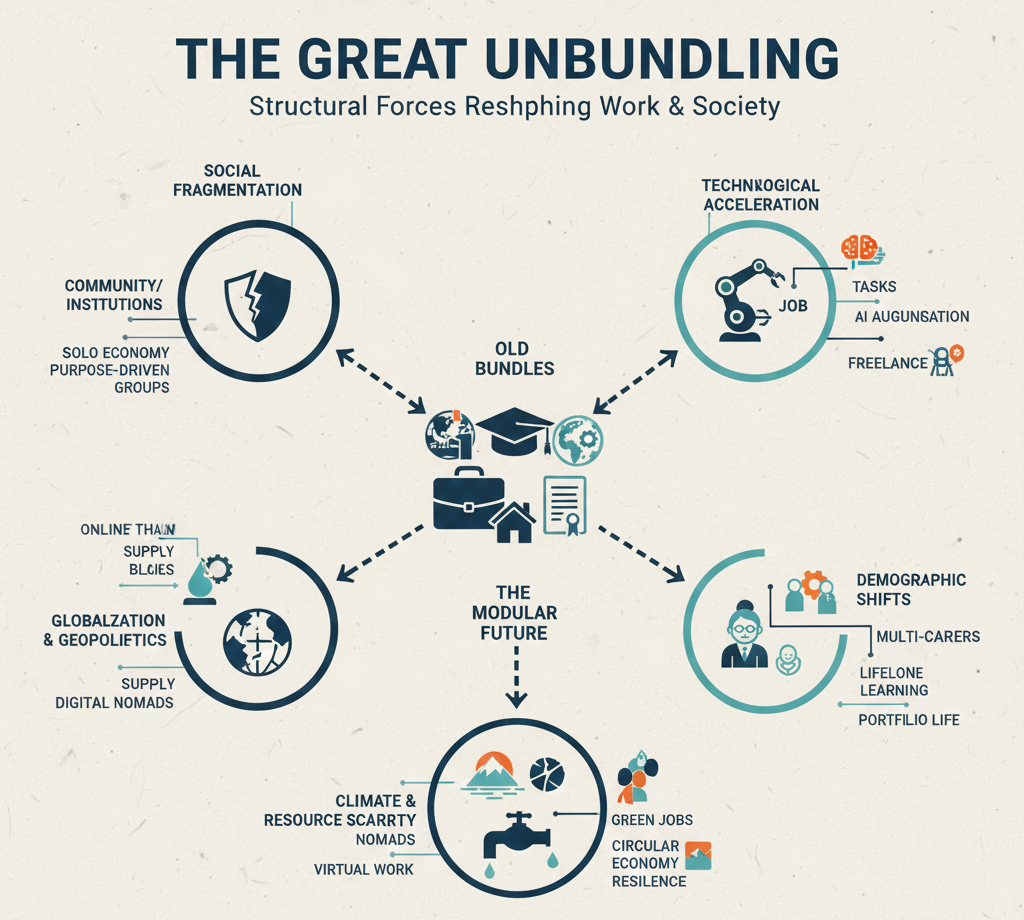
3 Bold Predictions Amid Great Unbundling
#1: Careers Will Become Multi-Phase Rather Than Multi-Company
Longer life expectancy and slower economic growth in many regions imply longer working lives. Gerontocracy is set to get new meaning, given the trend. OECD data suggests that mid-career transitions are rising, especially in technology and knowledge sectors. However, trends differ across countries; emerging markets with younger populations may see slower shifts. Nonetheless, careers in general are going to be a long journey, well into 70s and 80s of one's life.
#2: AI-Symbiotic Workers Will Command a Premium
Professionals who blend machine capabilities with human judgement will likely earn more, but gains will cluster in high-value sectors (finance, advanced manufacturing, consulting, R&D). Lower-income economies may experience delayed adoption. However, the need for mastering various AI tools would be felt far and wide. Being "AI-aware" will be equivalent to what is "digital-native" today.
#3: Career Curves Will Resemble S-Curves, Not Straight Lines
Growth will occur in cycles: plateau, reinvention, acceleration. Just like how we started this series from awakening all the way to designing. Professionals will have to adapt continuously to new realities consistently. Yet this is most applicable to knowledge workers; fields like healthcare, construction and logistics will follow more gradual transitions.
These predictions are directional, not deterministic. As explored in Designing Your Career, intention must replace drift; agency becomes the anchor in a volatile environment. Labour markets are shaped as much by geopolitics and policy as by technology. However, not all workers have equal access to reskilling. Not all countries have equal digital infrastructure. Not all industries are equally exposed to AI. These shifts will be mediated by public policy, infrastructure readiness, and cultural attitudes toward risk and retraining, factors that differ sharply between India, Southeast Asia, Europe, and the US.
Furthermore, high-exposure sectors—finance, software, professional services—will see rapid reconfiguration driven by AI augmentation. Meanwhile, healthcare, manufacturing, and construction will experience slower but steadier shifts driven by demographic demand and robotics adoption. Informal sectors may remain largely untouched in the near term. Nonetheless, this unbundling trend will continue.
Technology's role, we believe, is not to romanticise reinvention but to democratise it.
Architecture for Adaptive World
Therefore, in this new reality, the most successful professionals are not those who climb the fastest, but those who adapt the quickest. Career X.0 is not a fixed structure but a set of principles for navigating a fluid world.
- From Job Titles to Skill Portfolios: Forget what your business card says. Your true value lies in your unique combination of skills: both technical know-how and uniquely human capabilities like empathy, creativity, and complex problem-solving
- From Linear Paths to Networked Growth: Growth is no longer just vertical. It is omnidirectional: moving laterally to gain new experiences, taking on project-based work, and even stepping back to upskill. Think of your career as a lattice or a network, not a ladder
- From "Learning to Work" to "Working to Learn": Education is no longer a one-time event that happens at the start of your life. In an era where the half-life of a technical skill is estimated to be just five years, continuous, lifelong learning is the only path to sustained relevance.
Career X.0 architecture offers a path, but its feasibility varies widely. Technology's role, we believe, is not to romanticise reinvention but to democratise it: reducing cognitive, financial and logistical barriers to learning. The key insight is subtle but profound. Reinvention is not an act of ambition, but of alignment:aligning career identity with economic reality.
Career Audit
Is your career built on outdated 2.0 foundations? Don't wait for the next disruption to find out. Take 15 minutes today to audit your skills.
Within the next 30 days:
-Audit your skills based on current role demands
-Identify one task where AI can augment productivity
Within 90 days:
-Build a repeatable learning system (courses, micro-learning, peer groups)
-Update your skills portfolio, not just your CV
Within 6 months:
-Redesign your role with AI integration in mind
-Develop one cross-functional capability aligned with future shifts in your industry
Career X.0 era does not guarantee stability, nor does it promise uniform opportunity. But it offers a framework that matches the reality of modern work: dynamic, multi-phased, and shaped by human judgement as much as by machine intelligence. In this environment, the most resilient workers will be those who pair adaptability with intentional design—updating their skills, assumptions, and identities as the world evolves.