
It is a Monday morning strategy meeting, sometime in 2026. The CEO opens with a plan. Before the coffee has gone cold, the most junior person in the room, two years out of college, badge still slightly too shiny, has already run the plan past three AI models overnight and found a hole in the Q3 numbers that nobody else caught. She says so, politely. The room goes quiet in the specific way rooms go quiet when something structural has just happened and everyone feels it before anyone can name it.
Nothing about this scene required her to be smarter than the CEO. It only required her to have a laptop. And that, it turns out, is the whole story.

Before asking what leadership becomes next, we should ask a blunter question: why did anyone ever follow a leader in the first place? Across history, the answer sorts into four buckets, and it is worth being honest about how unflattering some of them are. People followed out of coercion: obey or be harmed. They followed out of tradition: this office has always been obeyed, and asking why is itself the offence. They followed out of ownership: whoever owns the factory directs the people who don’t. And they followed out of expertise: this person, demonstrably, knows more than I do about the thing we’re both trying to do.
The modern corporation likes to think it left the first three behind. It hasn’t, entirely. But its official self-image rests almost entirely on the fourth: the manager is the person who knows more. Information flows up, decisions flow down, and the arrangement is legitimate because the person at the top has the deepest experience.
For most of the twentieth century, this was a reasonable description of reality, because it was expensive to know things. A twenty-five-year-old could not acquire, in an evening, the pattern-recognition a fifty-year-old had built over three decades. The org chart was, roughly, a map of who had paid the most in accumulated information cost. Following your boss was a reasonably efficient way to borrow judgment you hadn’t yet had time to earn.
The corporate era ran on one bargain: the leader knows more. That bargain is now unenforceable.
That is the sentence this whole series exists to unpack. It is also an old debt coming due. Work X.0 named the term Leadership X.0 in passing, without yet explaining it. This series is the explanation.
Generative AI did not merely make information easier to find; search engines already did that. It made synthesis cheap: the ability to take a messy pile of facts and turn it into an argument, a forecast, a recommendation. Synthesis was always the expensive part, the part that used to require the fifty-year-old. Now it is available to whoever asks the right question, at two in the morning if they feel like it. The junior analyst with a good prompt can produce a competitive teardown that once took a strategy team a week. This is not a controversial claim anymore. It is Tuesday.
Which leaves the org chart’s official justification looking threadbare. If knowing more no longer requires seniority, if it requires, roughly, curiosity and a laptop, then an authority structure built on the premise of superior knowledge has had its foundation quietly removed while the building still stands. Buildings rarely fall down on schedule. But the cracks are showing up in exactly the places you would expect: not in what people say about their bosses, but in what they are quietly declining to do.
The Cracks, Measured
Start with trust. The 2026 Edelman Trust Barometer contains a finding that should unsettle anyone running a company: seventy-five percent of people say CEOs are obligated to be a stabilising, trustworthy voice, yet only forty-four percent think they are actually doing it. That is not a trust deficit. That is a credibility deficit, which is worse: people are withholding faith after looking closely, not out of ignorance.
Then there is the generation entering the workforce under these conditions. In the West, the pattern is stark. Multiple surveys put the share of Gen Z professionals deliberately avoiding management roles somewhere between half and three in five; the industry now calls it conscious unbossing. Not laziness in a hashtag. Management, as currently designed, looks like more accountability bolted onto less actual authority, for a title that no longer buys automatic deference.
In India, the picture complicates the story usefully rather than simply repeating it. A recent Deloitte survey found that ninety six percent of Indian Gen Z respondents are interested in senior leadership roles, yet only nine percent name it as their primary career goal right now. Fifty six percent rank a sense of purpose above compensation when choosing a job. This is not rejection of leadership. It is a refusal to chase the title before the reasons for holding it are in place, which is arguably a more demanding standard for legitimacy than conscious unbossing, not a softer one, and a useful reminder that this generational shift is showing up in different shapes across every geography Skillstr operates in.
When the smartest people in a system stop wanting to run it on the old terms, that is not a motivation problem. That is the system telling you something true about itself.
A short, necessary note. None of this means competence stopped mattering. Someone still has to actually be good at the job. What changed is which competence carries authority. Knowing the answer got cheap. Knowing which question to ask, and what to do once three different answers show up, did not.
The Legitimacy Ladder
If the “leader knows more” bargain is expiring, what is left standing? Think of legitimacy as a ladder with four rungs, and notice which ones AI can reach and which it cannot.
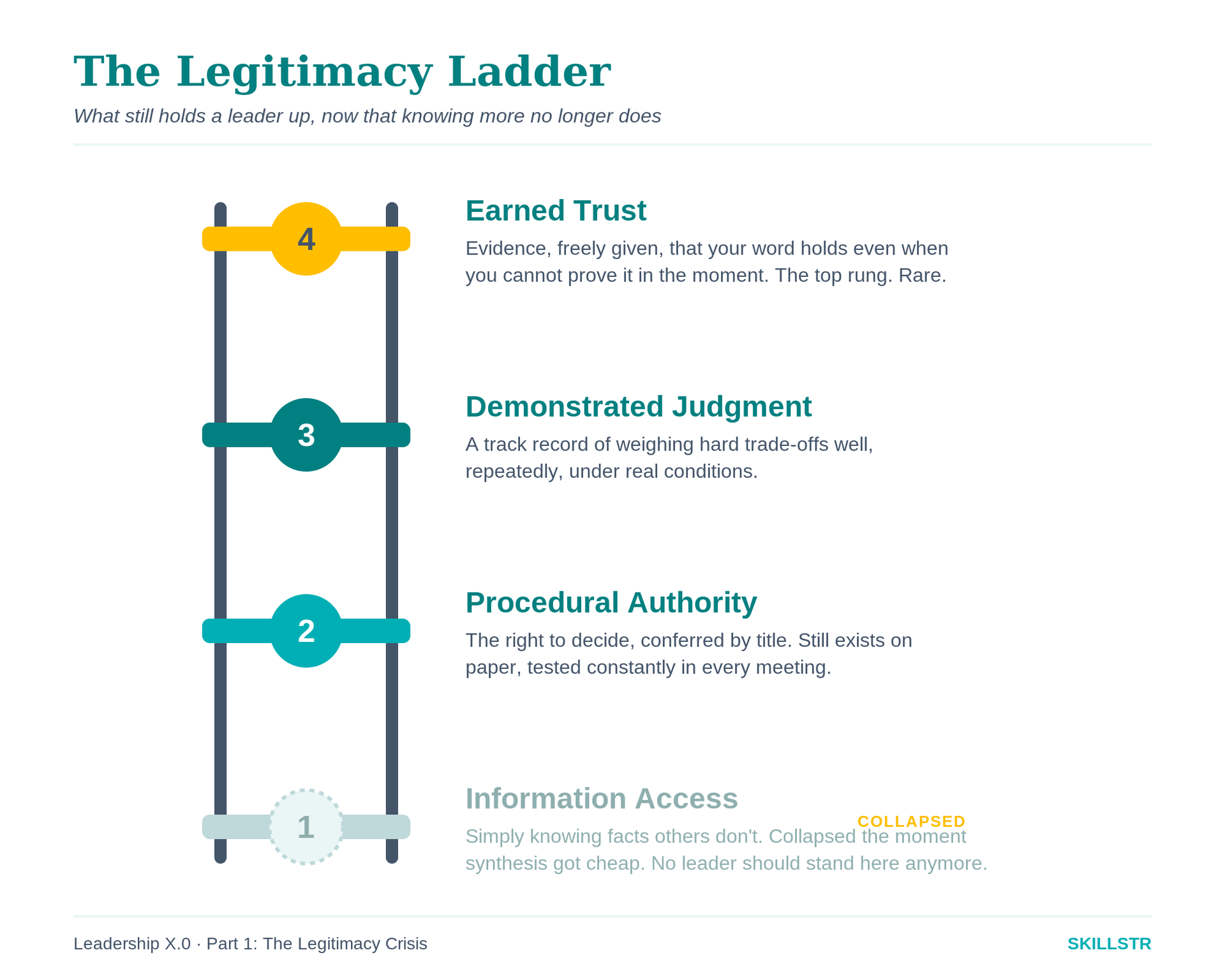
The bottom rung is information access: simply having facts others don’t. This rung is essentially gone. It collapsed the moment synthesis became cheap, and no leader should try to stand on it anymore. The second rung is procedural authority: the right to decide, conferred by title. It still exists on paper, but it is being tested constantly, in exactly the way our Monday morning meeting tested it. The third rung is demonstrated judgment: a track record of weighing hard trade-offs well, repeatedly, under real conditions. The fourth and top rung is earned trust: the accumulated evidence, given freely by people who could walk away, that this person’s word is reliable even when they cannot prove it in the moment.
Here is the uncomfortable part. Rungs three and four were always the real source of legitimate authority. Rungs one and two were always a proxy, a reasonably good one when information was expensive, but a proxy nonetheless. AI has not destroyed leadership’s foundation. It has stripped away the cheap scaffolding that let mediocre leaders stand on the bottom two rungs and call it authority. What is left exposed is the real question: can you demonstrate judgment, and have you actually earned trust?
There was always going to be a reckoning for leaders who never built anything above rung two. AI just moved up the date.
Anthropologists who study hunter gatherer bands find something worth flagging here. Those leaders held authority for exactly as long as their judgment kept matching reality, and were quietly deposed the moment it stopped. That older model has more in common with where leadership is heading than the one it was replaced by, and it is worth returning to properly next time.
Two Ways to Find Out
Morris Chang founded TSMC in 1987 and ran it, on and off, for most of the next three decades: stepping back in 2005, returning as CEO in 2009 when his handpicked successor struggled, and finally handing over to a co-CEO structure in 2013, built so the company would not need another Morris Chang. What is notable is not that Chang was brilliant. It is where he chose to build his legitimacy.
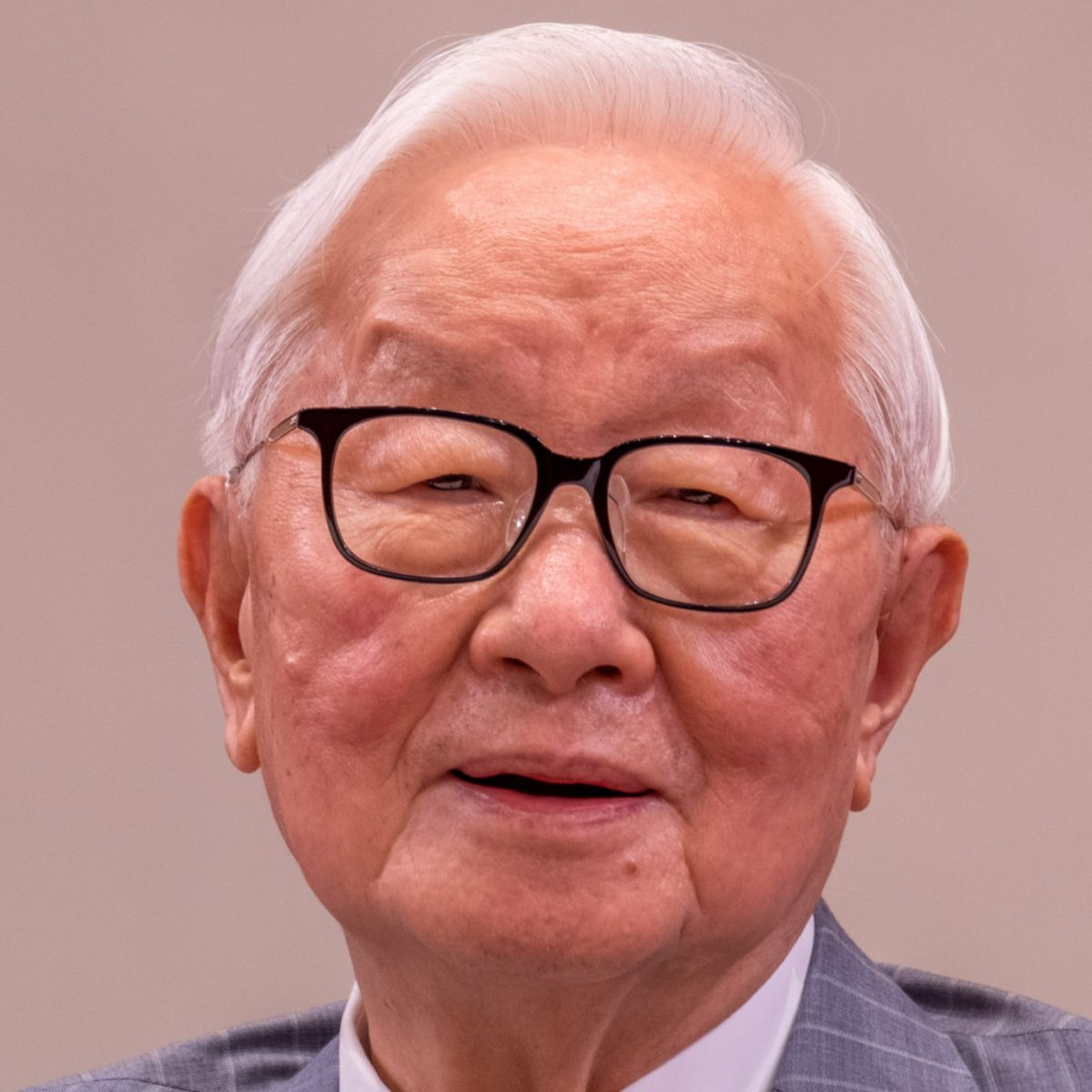
He built a culture where engineers were expected to challenge his reasoning with better reasoning, not simply defer to his title. He refused to lay off staff during the 2008 crisis, at real short-term cost, and banked decades of loyalty in return. He poured a consistently outsized share of revenue into research and development, year after year, long after anyone needed convincing. None of that is charisma. All of it is rungs three and four, built patiently, in public, which is presumably why TSMC survived his stepping back not once but twice, and is still standing on the same foundation today.

Now put beside it a company that tried to skip straight to the top. Adam Neumann took WeWork to a forty seven billion dollar valuation in January 2019 on a story about community, dressed up as a real estate business. Seven months later, WeWork filed to go public, and investors went looking for rungs three and four, and found neither.

The valuation did not erode. It evaporated: forty seven billion dollars to below ten billion in six weeks, Neumann removed as CEO by October, the company filing for bankruptcy four years later at forty four and a half million, roughly a thousandth of its peak. That is what happens when legitimacy is borrowed from charisma and never earned on the rungs that actually hold weight. Charisma can only get you thus far when the underlying foundations are missing in action.
Where the Old Bargain Still Holds
A fair objection deserves a straight answer before we move on. Information advantage has not vanished everywhere, and this essay would be dishonest if it implied otherwise. A junior surgeon with an excellent search engine is still no substitute for thirty years of hands on a scalpel, and a first officer cannot out reason a veteran captain during an actual engine failure at altitude. In domains where the cost of being wrong is measured in lives rather than quarters, hard won experience remains exactly as valuable as it ever was.
The claim here is narrower, and for most corporate leadership, more urgent. In the ordinary strategic and managerial decisions made in meeting rooms rather than operating theatres, information advantage has largely evaporated. That is precisely the terrain where legitimacy is now being tested, because it is the terrain most leaders actually occupy.
Micro-Experiment of the Week

In one meeting this week, quietly track two numbers. How many decisions default to whoever holds the senior title? How many default to whoever made the best reasoned case?

Do not intervene. Just count.

If the two numbers do not match, you have just measured your organisation's legitimacy gap.
None of this argues that leadership is finished, or hierarchy a relic. It argues that the justification for hierarchy has to move, from rungs that used to be expensive and are now free, to rungs that were always the real thing and are now, for the first time in a century, impossible to fake for long. The rest of this series is about what standing on rungs three and four actually requires: where leadership came from before there were org charts at all, how wildly the answer differs depending on which country you are standing in, and what it looks like to lead a team of people and machines who can all out research you by lunchtime.
People have never followed titles. They follow reasons. The org chart used to be a passable stand in for a reason. It no longer is, and the leaders who understand that first will spend this decade building the real thing, while everyone else keeps polishing the sign on the door.
Next in Leadership X.0: leadership is at least 100,000 years older than the org chart. Before Rome, before the guilds, before anyone had a title at all, hunter gatherer bands had a brutally effective way of keeping leaders honest, and it looked nothing like a performance review.