For the first time in history, we’re not just outsourcing labour. We’re outsourcing thinking itself. And the question isn’t whether AI is powerful. It’s whether we’re using it to think better or to avoid thinking altogether.
Technological progress has historically been defined by the extension of human capability. Early tools amplified physical strength. Machines multiplied output. Computers accelerated calculation. Each wave reduced the cost of effort and increased the scale at which work could be performed.
Artificial intelligence represents a different category of shift. It intervenes not at the level of effort, but at the level of cognition itself. It can generate language, synthesise information, identify patterns, and assist in reasoning. In doing so, it extends not what humans can do with their hands, but what they can do with their minds. This distinction is fundamental to Work X.0. Physical leverage changed how work was executed. Cognitive leverage changes how work itself is conceived.
What is Cognitive Leverage?
The progression of work under AI can be understood through the Cognitive Leverage Curve, which describes four stages:
- Manual Work: Tasks performed entirely by human effort and reasoning
- Assisted Work: Tools support execution, but humans retain control over thinking
- Augmented Work: AI contributes meaningfully to analysis, generation, and decision support
- Orchestrated Work: Humans coordinate systems of AI agents, tools, and workflows to produce outcomes
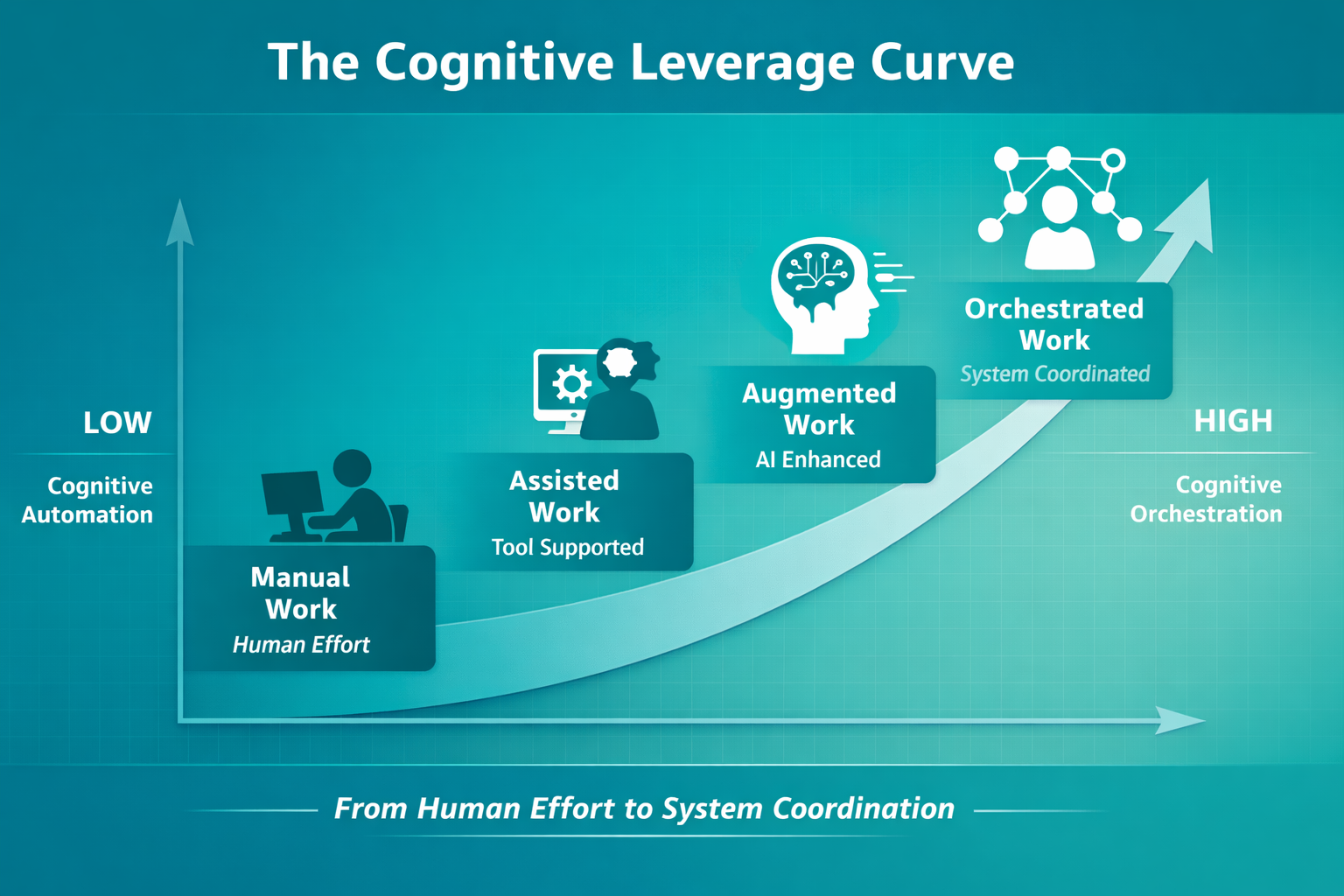
Most knowledge work today sits between assisted and augmented stages. The movement towards orchestration is uneven but unmistakable. The importance of this curve lies in how responsibility shifts. As systems become more capable, the human role moves upward: from execution to supervision, from analysis to judgment, from doing to directing as we discussed in The Great Unbundling.
AI does not remove work. It relocates where thinking happens.
Public discourse often frames AI in terms of job loss. This obscures the underlying mechanism. AI does not replace jobs in discrete units. It replaces components of cognition within those jobs. These components include information retrieval, pattern recognition, structured generation, and routine reasoning. Historically, these constituted a significant portion of knowledge work. As these become more accessible, their marginal value declines.
What remains and becomes more valuable are forms of thinking that are less easily codified: framing ambiguous problems, exercising judgment under uncertainty, integrating across domains, and making trade-offs where no clear answer exists.
The effects of this redistribution are visible in everyday work. Consider a common task: writing a strategic report. In a pre-AI workflow, the process required substantial time across multiple stages—research, structuring, drafting, and refinement. Each stage depended heavily on individual effort.However, in an AI-augmented workflow, the initial draft, supporting research, and even structural outlines can be generated rapidly. What changes is not the existence of the task, but the distribution of effort within it.
The human contribution shifts toward defining the problem, shaping the narrative, evaluating the output, and refining it in context. The task has not disappeared. It has been cognitively unbundled.
The Shift: From Cognitive Effort to Cognitive Offloading
The expansion of cognitive capability introduces a subtle but important risk. As systems become more effective, individuals may begin to rely on them not only for execution, but for thinking itself. Problem framing is deferred to the tool. Outputs are accepted without interrogation. Generation substitutes for understanding. This creates a form of competence that is operationally effective but structurally fragile. One cannot supervise a system one does not understand.
If you outsource thinking, you inherit the limits of the tool.
The paradox of cognitive leverage is that as tools become more powerful, the requirement for human depth increases. Without that depth, individuals risk becoming dependent on systems whose outputs they cannot meaningfully evaluate. As certain forms of cognition become widely accessible, the basis of value shifts. In earlier models, analytical ability and knowledge accumulation were primary differentiators. When analysis can be generated on demand, its scarcity diminishes.
Value migrates upward: to problem framing, judgment, orchestration, and what might be described as “taste”: the ability to discern quality and direction in ambiguous contexts.This does not eliminate expertise, but it changes its nature. Expertise is no longer defined solely by what one knows, but by how one navigates what is not yet fully known.
In a world of abundant answers, the scarce resource becomes good questions.
The ability to work effectively with AI becomes a form of economic literacy. It determines not only productivity, but access to opportunity. AI literacy is often reduced to familiarity with tools. At a deeper level, it involves understanding how to structure problems, when to rely on machine outputs, and how to evaluate them critically. This is not a static skill. It evolves with the tools themselves. In a system where capabilities change rapidly, the advantage lies not in mastering a specific tool, but in adapting one’s thinking to new configurations of capability.
The rise of cognitive leverage reshapes how learning occurs. There is a temptation to bypass effort: to generate solutions without engaging with the underlying process. While efficient in the short term, this limits the development of deep understanding.
Struggle is not incidental to learning; it is integral to it. It forces engagement with structure, reveals gaps in understanding, and builds mental models that persist beyond any specific tool. If this process is consistently outsourced, individuals may become proficient in using systems without developing the capacity to operate independently of them.
The objective is not to eliminate effort, but to direct it towards higher-order thinking.
From Execution to Orchestration
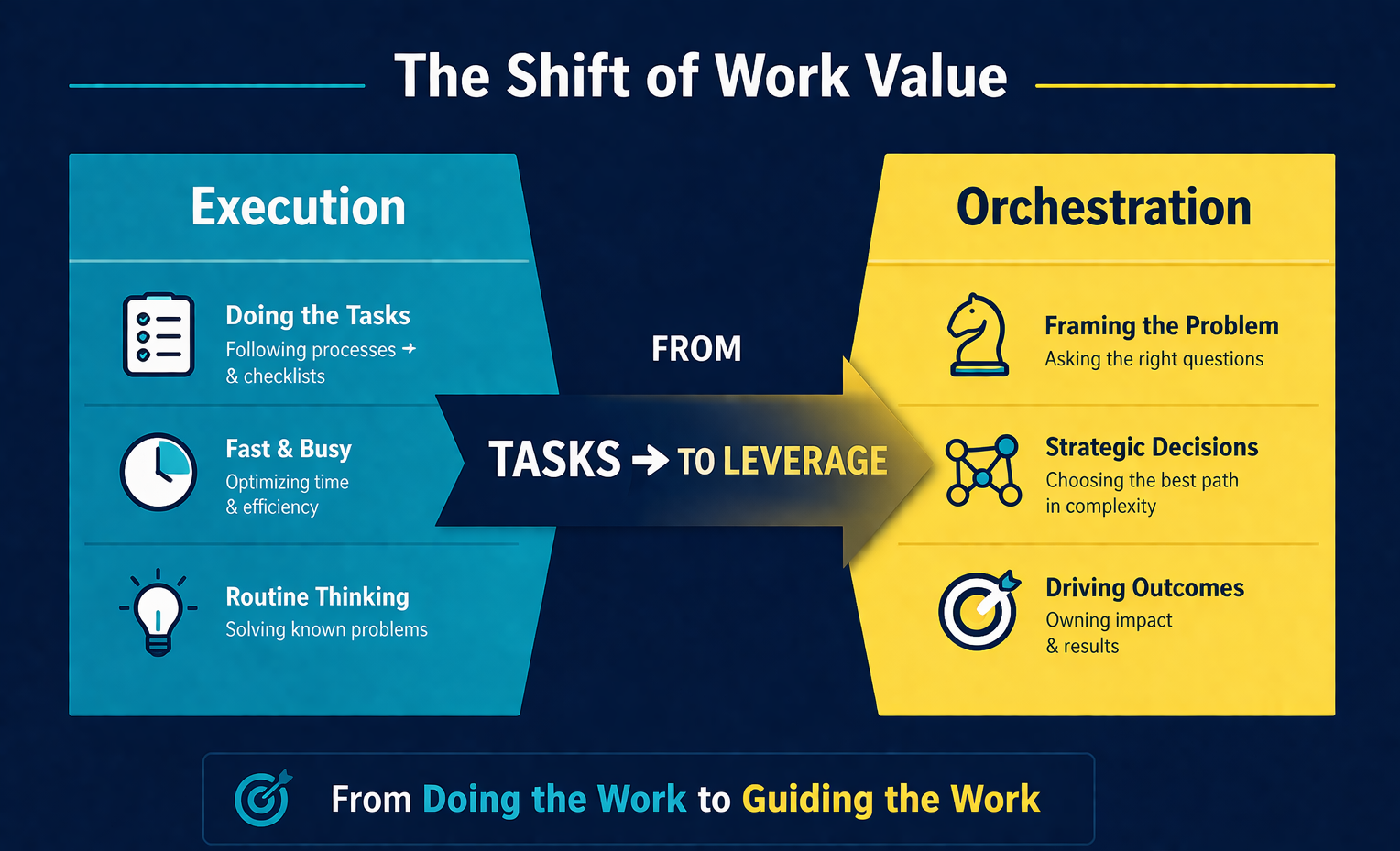
As cognitive tasks are redistributed, the structure of work evolves. Value shifts from the ability to execute tasks to the ability to orchestrate systems of execution. This involves defining objectives, decomposing outcomes, allocating tasks across humans and machines, and integrating outputs into a coherent whole. The individual becomes less a performer and more a designer of workflows. This aligns with the broader trajectory of Work X.0. As work becomes modular and tasks become unbundled, the central capability is not execution, but coordination.
In Work X.0, effort becomes invisible. Orchestration becomes decisive.
A Practical Lens

The implications of cognitive leverage can be observed through a simple exercise. Over the course of a week, identify one task where AI meaningfully contributes to your thinking.

Observe not only what becomes faster, but what changes in your role. Which parts of the task are reduced? Which become more important? Where does your attention shift?
This reveals the movement along the Cognitive Leverage Curve—from execution towards orchestration.
Artificial intelligence does not eliminate the need for human cognition. It changes its structure and distribution. Certain forms of thinking become widely accessible and less differentiating. Others become more central and more valuable. The boundary between human and machine cognition becomes fluid. This is not a transition from thinking to not thinking. It is a transition from one kind of thinking to another. In Work X.0, thinking is no longer scarce, judgement is. In the next part, our focus shifts to skills: how they are built, how they compound, and why the speed of learning may matter more than the depth of existing expertise in a system defined by continuous change.