
As we explore in Work X.0, the idea of a career rested on a simple premise: that progress would be linear, predictable, and largely controllable. One would choose a field, enter at the bottom, accumulate experience, and steadily move upwards. The metaphor of the ladder was not accidental; it reflected a world in which work itself was structured, stable, and hierarchical.
What has changed over the last decade is not merely the pace of careers, but the nature of work itself. Yet, while work has undergone a structural transformation, careers continue to be understood and often managed as if that transformation never occurred.
This has created a subtle but pervasive dissonance. Many individuals find themselves progressing on paper—changing roles, gaining experience, even earning more while simultaneously feeling that the underlying system no longer behaves in predictable ways. This is not a failure of ambition or capability. It is the result of a deeper structural misalignment.
At its core lies what can be described as the Career–Work Mismatch: persistence of linear career models within a fundamentally non-linear system of work.
From Linear Paths to Non-Linear Systems
The traditional career model assumes sequence. It presumes that progress unfolds step by step, that roles are clearly defined, and that each stage prepares one for the next. This assumption held true in a world where work itself was stable, where roles changed slowly, industries evolved incrementally, and organisations acted as the primary gatekeepers of opportunity.
That world has been replaced by something far less orderly. Work today is increasingly project-based rather than role-bound, distributed rather than hierarchical, and dynamic rather than fixed. Teams assemble and disband around problems, capabilities matter more than titles, and the boundaries between functions are increasingly porous.
In such an environment, the idea of a career as a linear path begins to lose coherence. Individuals are effectively navigating a network while still relying on the logic of a ladder. The result is not just inefficiency, but confusion an inability to map effort to outcome with the clarity that earlier career models provided.
As we explored in Career X.0 series, it is helpful to describe the evolution of careers in stages: from the survival needs of Career 1.0, to the industrial stability and corporate ladders of Career 2.0, to the digital driven ethos of Career 3.0, and finally to the adaptive, self-directed model of Career X.0. This framing suggests a natural progression, as though each stage represents an improvement on the last.
However, this interpretation obscures a more important reality. Career X.0 is not simply an upgrade. It is, in many ways, an adaptation to a system that has already changed. As work became more fluid, individuals were forced to become more flexible. As roles became less stable, careers became less linear. In this sense, Career X.0 is less a proactive evolution and more a reactive adjustment, a workaround for the breakdown of the structures that previously sustained linear careers.
Career X.0 is not simply an upgrade. It is, in many ways, an adaptation to a system that has already changed
Why the Career Ladder Lost Its Relevance
The traditional career ladder relied on a set of assumptions that no longer hold. First, it assumed that roles were stable. Today, roles are increasingly hybrid, often combining responsibilities that would previously have been distributed across multiple functions. Job descriptions struggle to keep pace with reality. Second, it assumed that skills compounded over long periods. In practice, many skills now have shorter half-lives, with technological and organisational changes accelerating their obsolescence. Third, it assumed that organisations controlled the flow of opportunity. While institutions remain important, access to opportunity is now far more distributed, enabled by networks, platforms, and individual visibility.
Despite these shifts, the ladder remains a dominant mental model. Many continue to optimise for promotions, titles, and tenure, even as the mechanisms that once made those signals meaningful have weakened.
The result is a growing misalignment between what is pursued and what is rewarded. What appears stable may, in fact, be fragile. What appears incremental may, in fact, be limiting. In response to these changes, many individuals have moved away from single-track careers towards more diversified, portfolio-like approaches. They engage in multiple roles, projects, and domains simultaneously, creating a broader base of opportunity and resilience.
While this shift offers greater flexibility, it introduces a new set of challenges, particularly around identity and coherence. In traditional career models, identity was largely derived from role and organisation. One’s professional self was legible and externally validated.
In a portfolio model, identity must be actively constructed. Individuals must continually articulate what they do, how their various activities connect, and what constitutes progress. This can create a sense of fragmentation, where the absence of clear markers makes it difficult to assess direction or success.
In a portfolio model, identity must be actively constructed.
Thus, while portfolio careers address the limitations of linearity, they also expose the absence of a stable underlying framework for meaning.
Rethinking Stability in a Changing System
Perhaps the most significant shift is in the nature of stability itself. In earlier models, stability was external, provided by organisations, industries, and relatively predictable career paths. To have a stable career was to be embedded within a stable system.
Today, those systems are less predictable. As a result, stability has not disappeared, but it has become internalised. It is increasingly a function of how individuals design their own capabilities, relationships, and modes of learning. This internal stability is built through combinations of skills rather than singular expertise, through networks rather than hierarchies, and through an understanding of how value is created rather than adherence to predefined roles. In this context, stability is no longer something one finds. It is something one actively constructs.
Much of the discourse focuses on underlying concept of Career X.0, the need for adaptability, continuous learning, and reinvention. While these are valid responses, they do not address the underlying cause. The deeper transformation lies in Work X.0. Work has become modular, distributed, and increasingly augmented by technology. It is less about occupying a role and more about contributing to outcomes within fluid systems.
The deeper transformation lies in Work X.0.
Careers, however, continue to be framed in terms of roles, organisations, and timelines. This creates the central tension: a modern system of work operating alongside an outdated model of careers. Until this tension is resolved, individuals will continue to experience friction, regardless of how effectively they optimise within the old framework.
The most meaningful shift, therefore, is conceptual. Careers must be understood not as paths to be followed, but as systems to be designed. This reframing changes the nature of decision-making. Instead of asking what the next step should be, the more relevant question becomes how one’s overall system generates opportunities over time. Such a system includes not only skills and experience, but also visibility, networks, and the ability to learn and adapt continuously. This does not eliminate uncertainty. Rather, it changes how uncertainty is managed, from something to be avoided to something to be navigated through design.
A Practical AuditThis structural shift can be observed in everyday career decisions. When growth is equated primarily with promotions, when identity is confined to a single role, when stability is assumed to come from an organisation, or when learning is treated as episodic rather than continuous, the underlying model remains linear.
Each of these assumptions reflects a version of the world that is increasingly misaligned with how work operates today. Recognising these mismatches is the first step towards redesigning one’s approach.
Beyond the Ladder
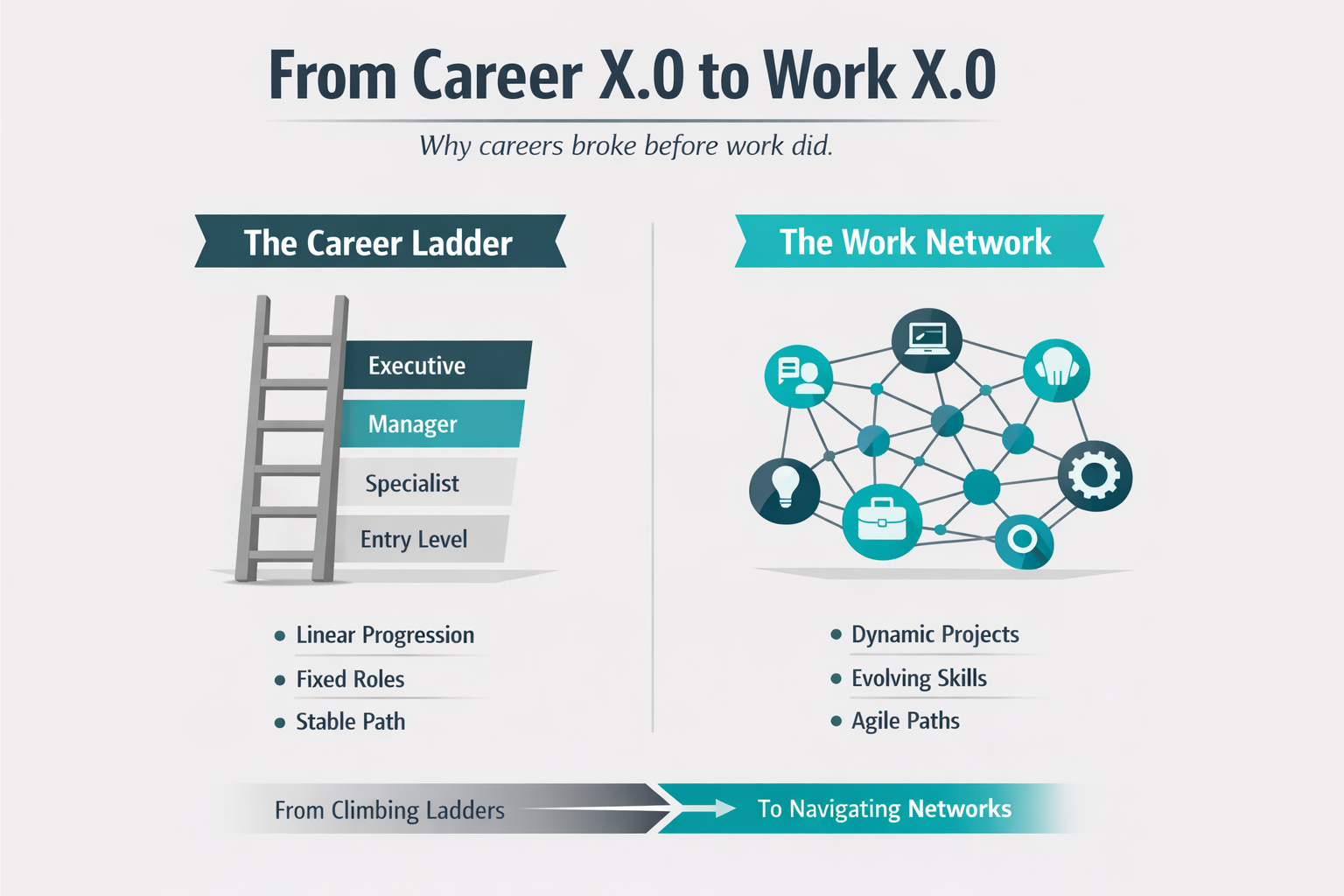
The appeal of the traditional career model lay in its clarity. It offered a sense of direction, a set of milestones, and a relatively stable definition of success. But that clarity was contingent on a particular structure of work, one that has since evolved.
The breakdown of the career ladder is not, therefore, a failure of individuals, but a consequence of structural change. What replaces it is not a lack of structure, but a different kind of structure one that is less visible, less prescriptive, and more dependent on individual design. A career lattice for a distributed system of work perhaps.
Understanding this distinction is critical. Without it, one risks optimising for a system that no longer determines outcomes. In the next part, the focus shifts to Work X.0 itself: what it is, how it functions, and what it demands of those operating within it. Only by understanding work at this level can careers be meaningfully reimagined.